Most traders treat funding as an annoying fee. It is actually the cleanest structural edge in crypto — a payment that has to exist, that you can collect without betting on price. This article breaks down where that edge comes from, how to read funding properly, a real $20,000 / 5× example using live ORBIT numbers, and why funding arbitrage beats directional futures over a long enough horizon. Every figure below is pulled live from the Funding Screener.
1. What is funding, really?
Perpetual futures have no expiry. To keep the perp price glued to spot, exchanges use a funding rate — a small payment exchanged directly between longs and shorts every interval (1h or 8h, depending on the venue).
- Funding positive → longs pay shorts. The market is crowded long.
- Funding negative → shorts pay longs. The market is crowded short.
That is the whole engine. Funding is not a fee the exchange takes — it is a transfer between traders. Which means: if you sit on the side that receives, you get paid just for holding the position. No need to predict price.
2. Where the arbitrage comes from
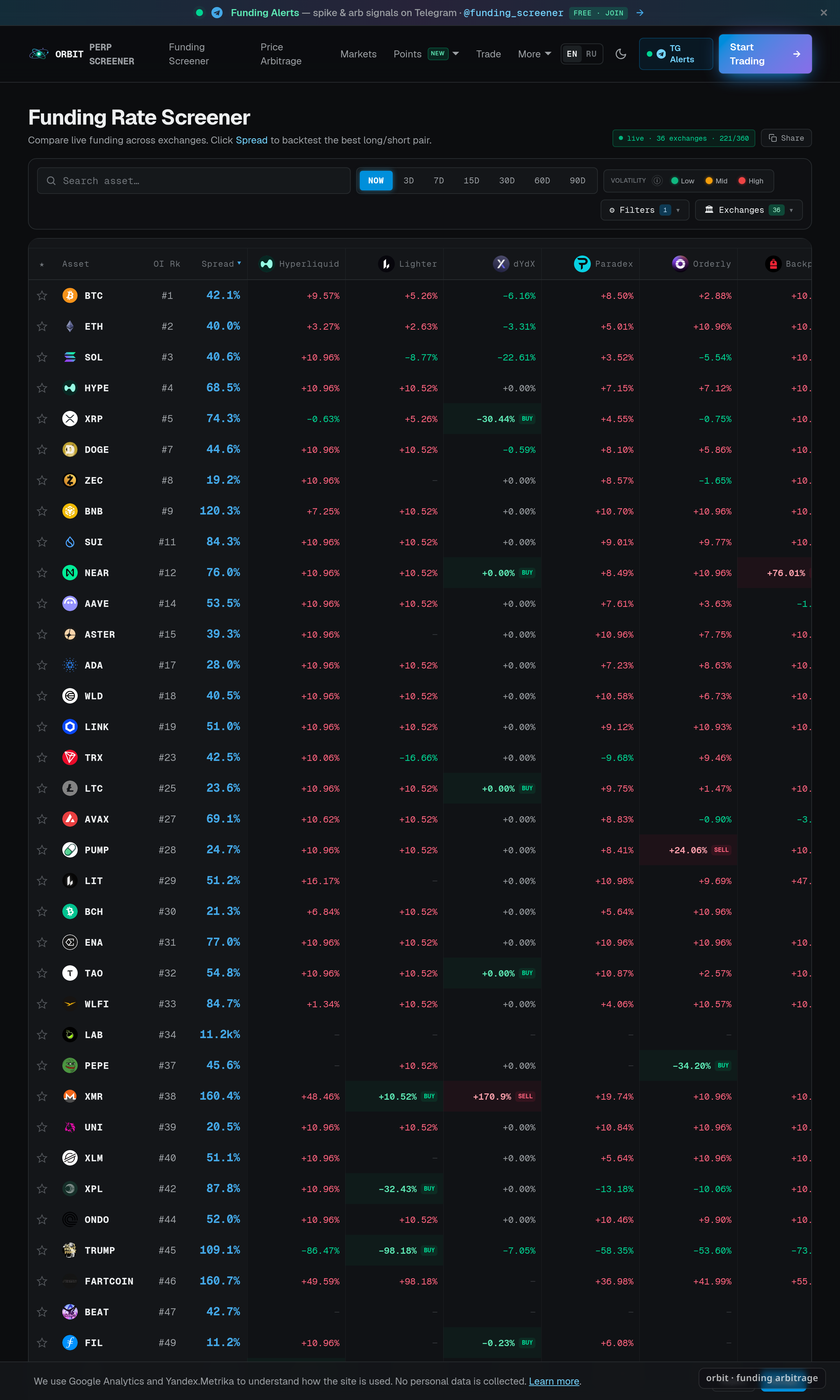
Here is the key insight most people miss: the same asset has a different funding rate on every exchange. BTC funding on Hyperliquid right now is not the same number as BTC funding on OKX, dYdX, or Extended. The crowd is positioned differently on each venue, so the rates diverge.
Go LONG where funding is negative (you get paid) and SHORT the same asset where funding is positive (you also get paid). Your price exposure cancels out — and you collect both funding streams.
This is delta-neutral funding arbitrage. You are not betting on BTC going up or down. You hold an equal long and short, so a $1,000 move up on one leg is a $1,000 loss on the other — net zero. The only thing you keep is the funding spread between the two venues.
3. How to read funding properly
A single funding number means nothing on its own. Three things separate a real edge from a trap:
- Annualize it. A "0.01% per 8h" rate sounds tiny — but that is ~11% APR. Always compare in annual terms, the same unit across venues.
- Check the interval. One venue pays every 1h, another every 8h. A raw rate comparison without matching intervals is meaningless — ORBIT normalizes this for you.
- Check liquidity and persistence. A 400% spread on a $50K open-interest altcoin is a phantom — you cannot enter size, and it flips in an hour. Stick to assets with deep books on both legs and a spread that has held for days.
4. A real example — $20,000, 5× leverage
Let us make it concrete. Say your capital is $20,000 and you run a conservative 5× leverage, split delta-neutral — so roughly $50,000 notional long and $50,000 notional short on the same asset (≈$100K total position, well within your margin).
Below is ORBIT’s backtester on a clean, liquid major — BTC, long OKX vs short Reya — over 7 days. Real settlement history, real fees, real orderbook slippage baked in:
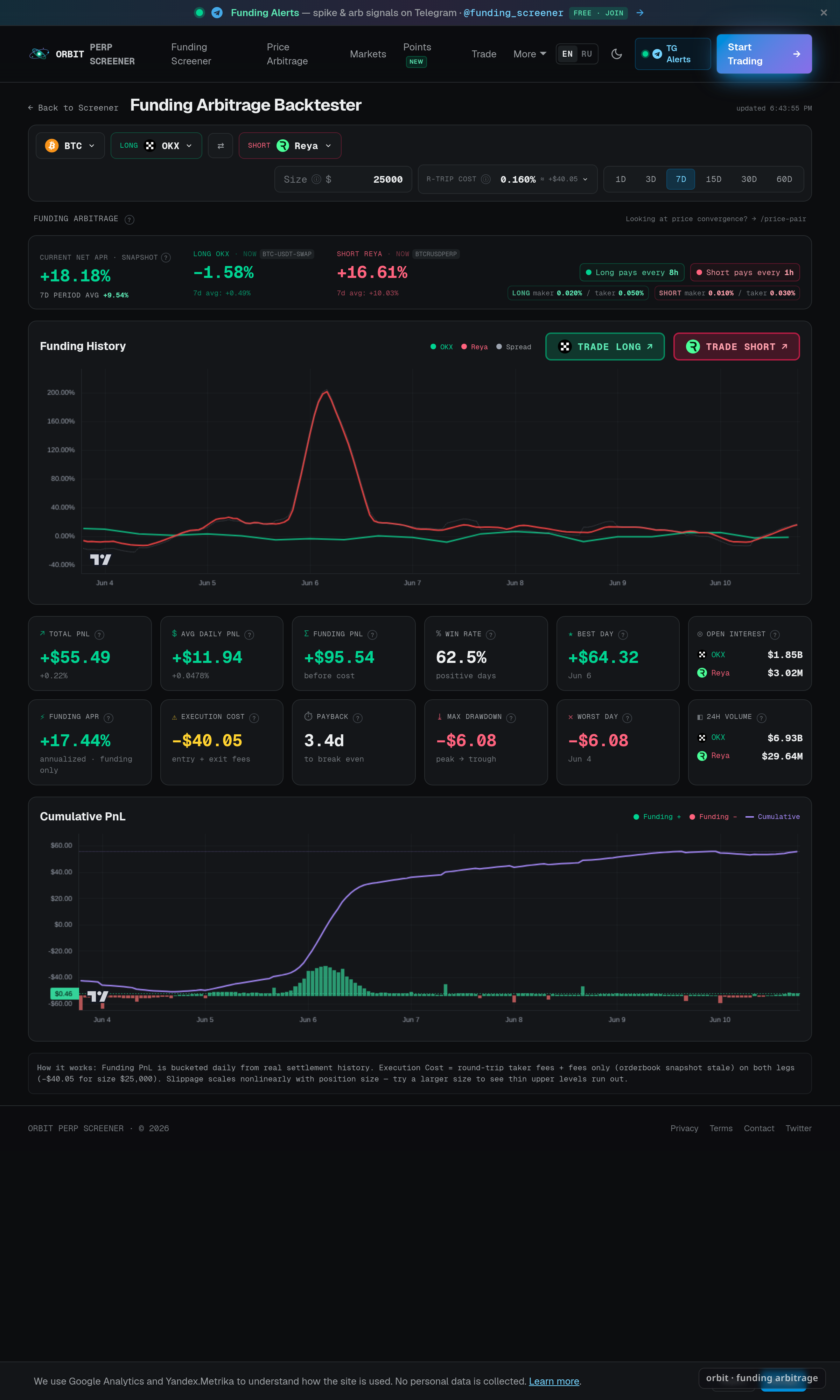
Scale that +17.44% APR onto a $100K delta-neutral position (your $20K at 5×): roughly $17,000 a year on the notional, which is about 85% on the $20K you actually put up — with no directional bet on price.
Why the backtester matters more than any APR badge
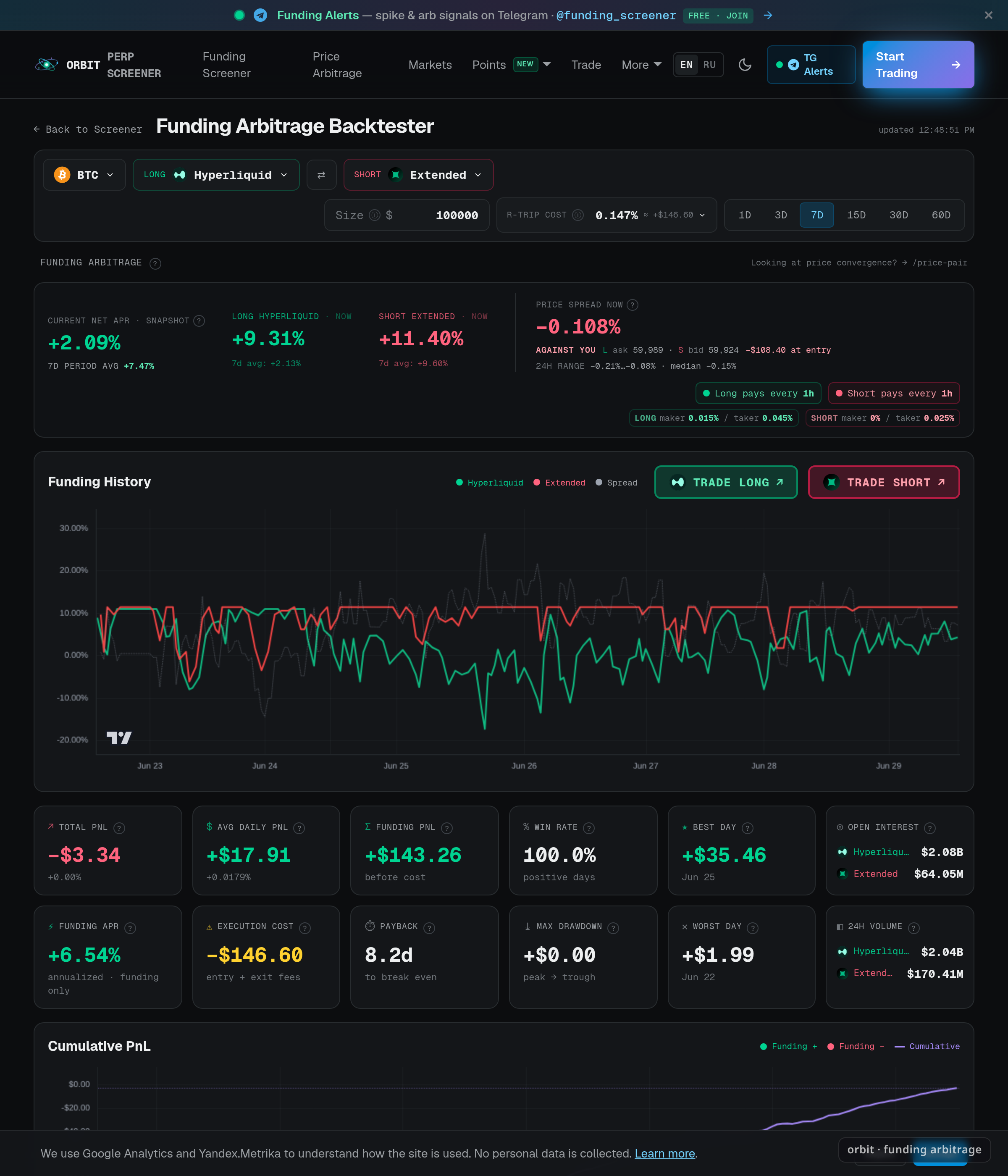
On thin spreads, fees and slippage can eat the entire edge. Look at this fresh BTC pair (Hyperliquid / Extended): funding looks positive, but the round-trip execution cost wipes the thin spread to roughly break-even.
5. Compare this to directional futures
| Directional futures | Funding arbitrage |
|---|---|
| You must be right on direction | Direction does not matter (delta-neutral) |
| Liquidation risk on a single move | One leg's loss = other leg's gain |
| Fees + funding work against you | Funding works for you |
| Most retail bleeds out over time | Edge is structural & repeatable |
The statistics on retail futures are brutal: the large majority of leveraged directional traders are net-negative over a long enough horizon. You are paying fees, paying funding when you are on the crowded side, and getting wicked out of positions. The house edge plus your own emotions grind the account down.
Funding arbitrage flips every one of those vectors. You are not predicting anything. You are collecting a payment that has to exist because the funding mechanism is what holds perps to spot. It is the closest thing to a structural, market-neutral yield in crypto.
6. Bonus: you can farm points at the same time
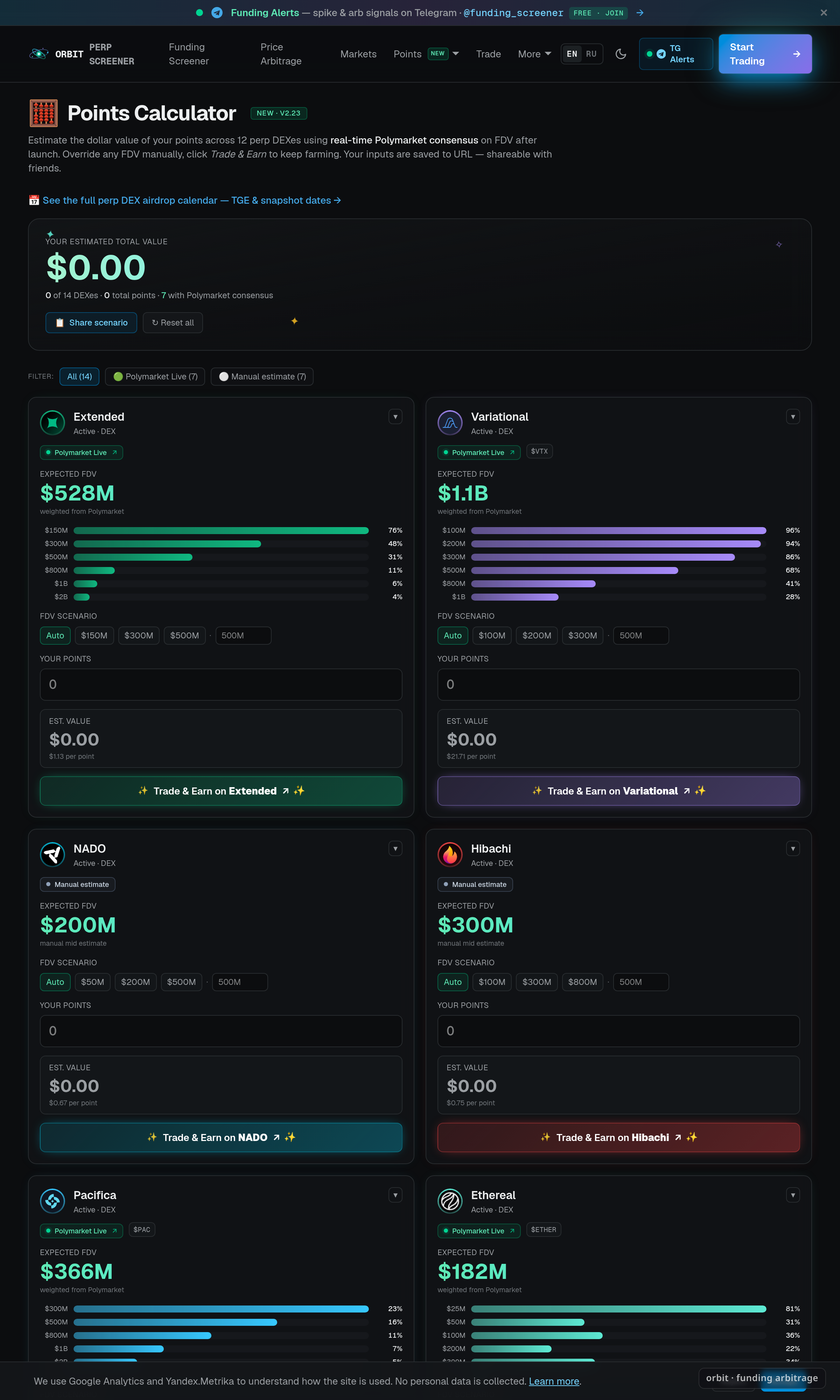
Here is the part that makes this genuinely asymmetric right now. Most of the perp DEXes you would use for one leg — Extended, Variational, Pacifica, Hibachi, NADO, Ethereal and more — have not launched a token yet. Trading volume on them earns points that convert to a future airdrop.
- Collects the funding spread (your base yield), and
- Generates volume on pre-token venues → farms points → potential airdrop on top.
7. The honest risk checklist
- Funding can flip. The spread you entered on can compress or reverse — watch it, do not set-and-forget.
- Single-leg liquidation. If one venue moves hard and your margin is thin, you can get liquidated on one side and lose your neutrality. Keep buffer, run modest leverage.
- Fees eat thin spreads. Always backtest with real cost. A 6% spread on a high-fee venue can be net zero.
- Venue risk. You are holding balances on two exchanges. Spread across reputable venues; do not over-concentrate.
- Execution drift. The price you enter at is not always the mid. Use the backtester’s slippage model as a reality check.
Bottom line
Funding arbitrage is, right now, one of the best risk-adjusted ways to earn in crypto: a structural, direction-neutral yield — and you farm pre-token DEX points on top of it.
Directional futures ask you to be right repeatedly while fees and funding bleed you. Funding arb asks you to do one thing well: read the spread, check the cost, and collect. That is a fundamentally better game.