The funding-rate gap between two exchanges is one of the few edges in crypto you can collect without betting on price direction. The problem is that most people never get past the theory. This guide is the opposite — it walks you through the exact ORBIT workflow, with real screenshots, real 7- and 30-day backtests, and a real $5,000 money example you can copy step by step.
- How a delta-neutral funding trade actually makes money — in one paragraph.
- How to find a live spread on the Funding Screener and sanity-check it in the backtester.
- What $5,000 at 5× leverage would have earned over the last 7 and 30 days — using real ORBIT numbers.
- How to stack DEX points on top for a second income stream, and where to sign up for referral perks.
What delta-neutral actually means
A perpetual contract pays funding every 1, 4, or 8 hours. When it trades above spot, longs pay shorts; below spot, shorts pay longs. Every exchange computes its own rate, so the same coin can pay +60% annualized on one venue and −20% on another at the same moment.
Delta-neutral means you hold two equal, opposite positions: long on the venue that pays you, short on the venue that charges less. Price moves cancel out across the legs — if the coin pumps 10%, your long gains and your short loses the same amount. What is left is the funding gap, paid out every settlement window. For the full mechanics, see the beginner's guide; this article is about actually doing it on ORBIT.
Where the profit comes from
Three sources, in order of size: (1) the funding-rate spread itself, collected every settlement window; (2) on some DEX legs, points that convert to a future airdrop — a second yield on the same capital; (3) occasionally, basis convergence if you also caught a price gap. This guide focuses on the first two, which are the durable ones.
Step 1 — Find a live spread
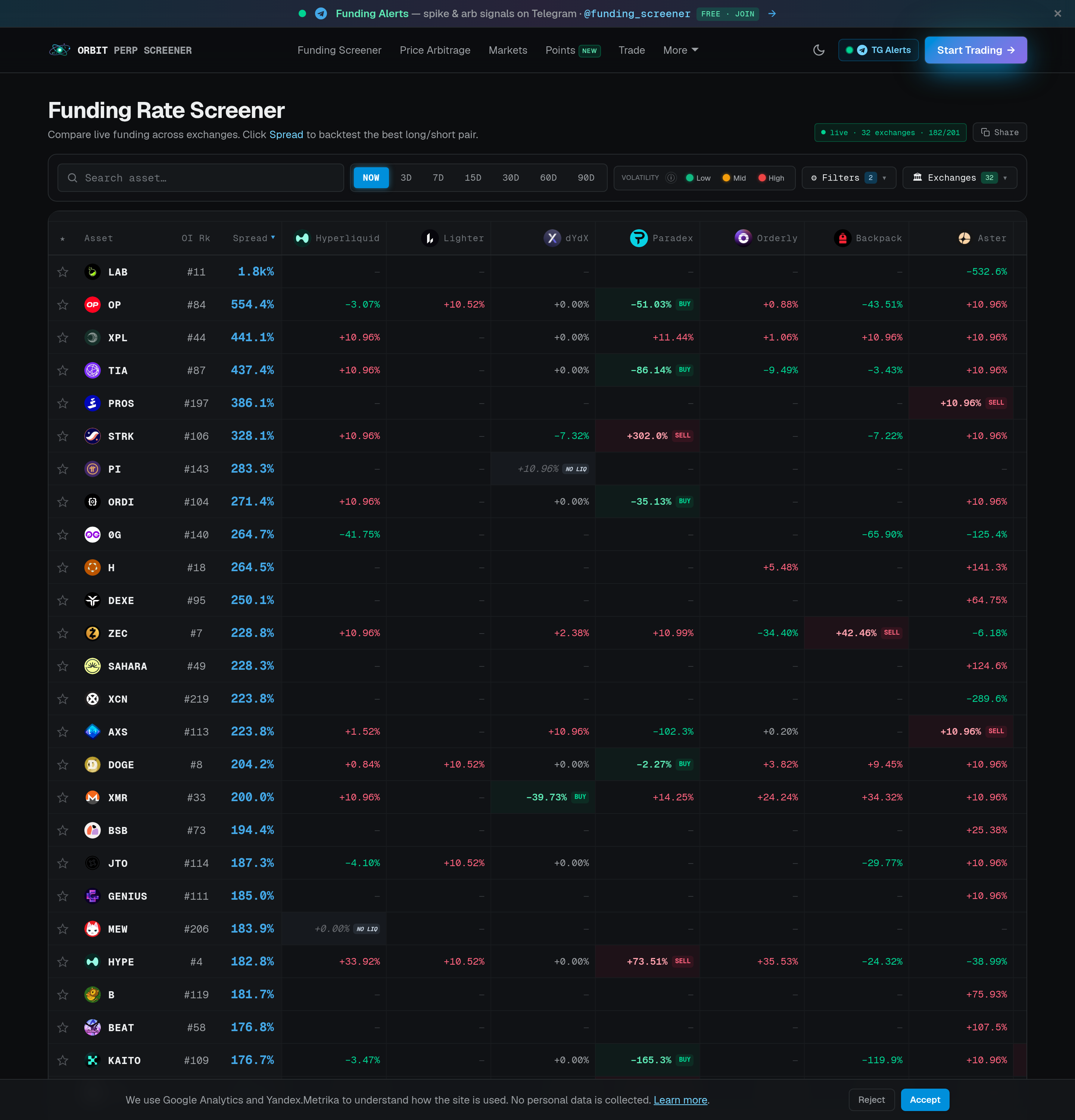
Open the Funding Screener. Each row is an asset; each column is an exchange. A green cell means funding is negative there — a long position gets paid. A red cell means funding is positive — a short gets paid. The Spread column ranks the gap between the best long and best short venue. Sort by Spread, set a Min OI filter (e.g. $1M) so you only see markets deep enough to actually trade, and watch the colored stability dots — a steady rate is worth far more than a one-hour spike.
Step 2 — Verify it in the backtester
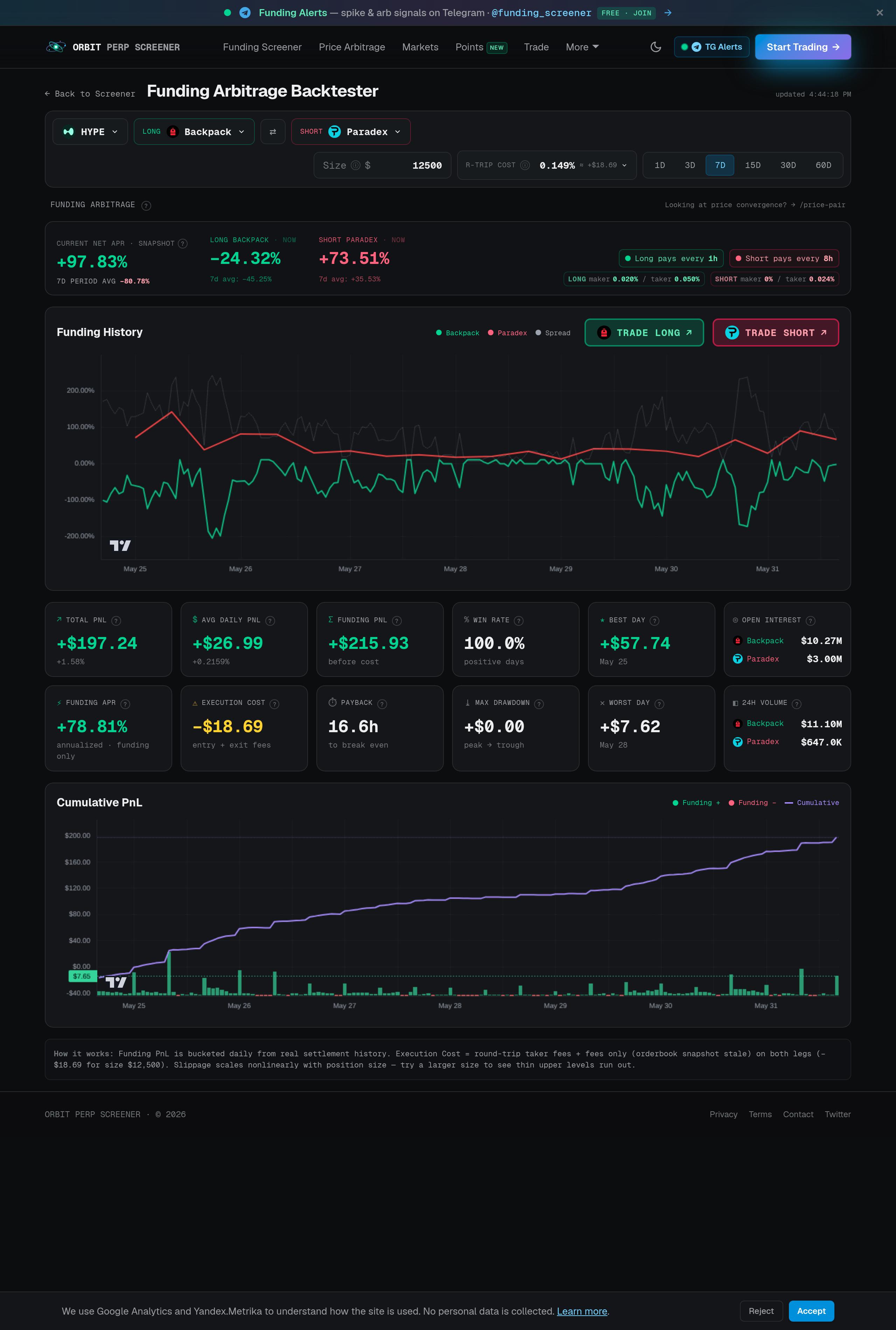
A headline spread is a snapshot — it can vanish in an hour. Before committing capital, click any spread to open the backtester. ORBIT replays the real funding history of both legs and, crucially, subtracts the real execution cost — taker fees on both venues plus live order-book slippage. The number it shows is net PnL, not a hand-waved headline.
The screenshot above is HYPE, long on Backpack and short on Paradex, sized at $12,500 per leg over 7 days. Net result: +$197.24 after a $18.69 round-trip cost, 100% of days green, fees paid back in under a day. The FUNDING APR tile reads about 79% annualized at this size.
Step 3 — Open the position on the real exchanges
The backtester told you a pair is worth trading. Now you actually open it — on two exchanges at once. Let us use a concrete BTC example: long on Hyperliquid (it pays you funding) and short on Paradex (you collect there too). The screens below are the real trading interfaces, so you can follow along click for click.
Before you touch the order ticket, read the funding on each venue. On Hyperliquid the BTC perp shows its funding rate and a live countdown to the next settlement right under the price. On Paradex the BTC-USD perp shows its 8-hour funding plus the live order book. You want to be long where funding is paid to longs and short where it is paid to shorts — the screener already picked those for you, this is just the confirmation.
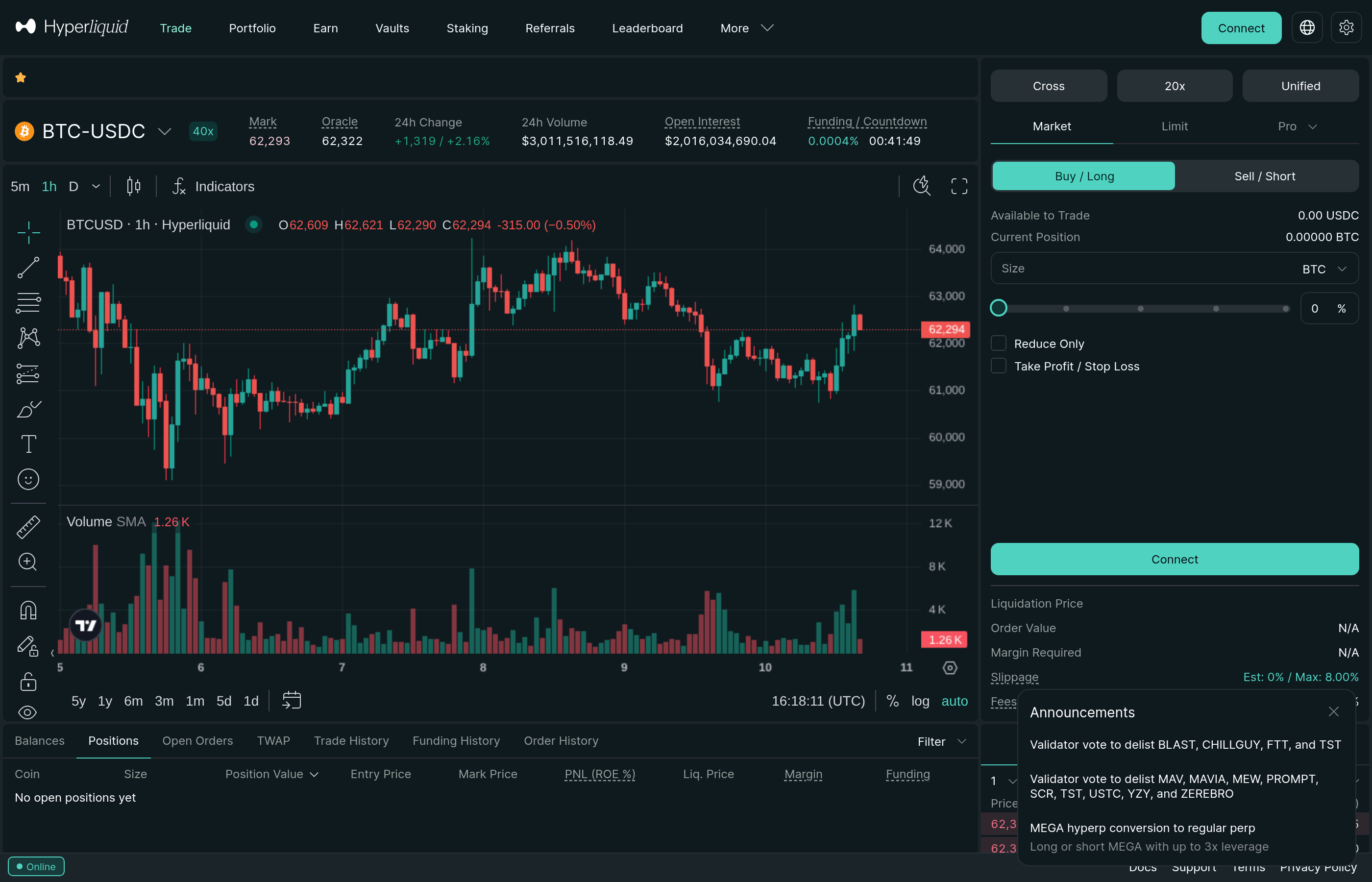
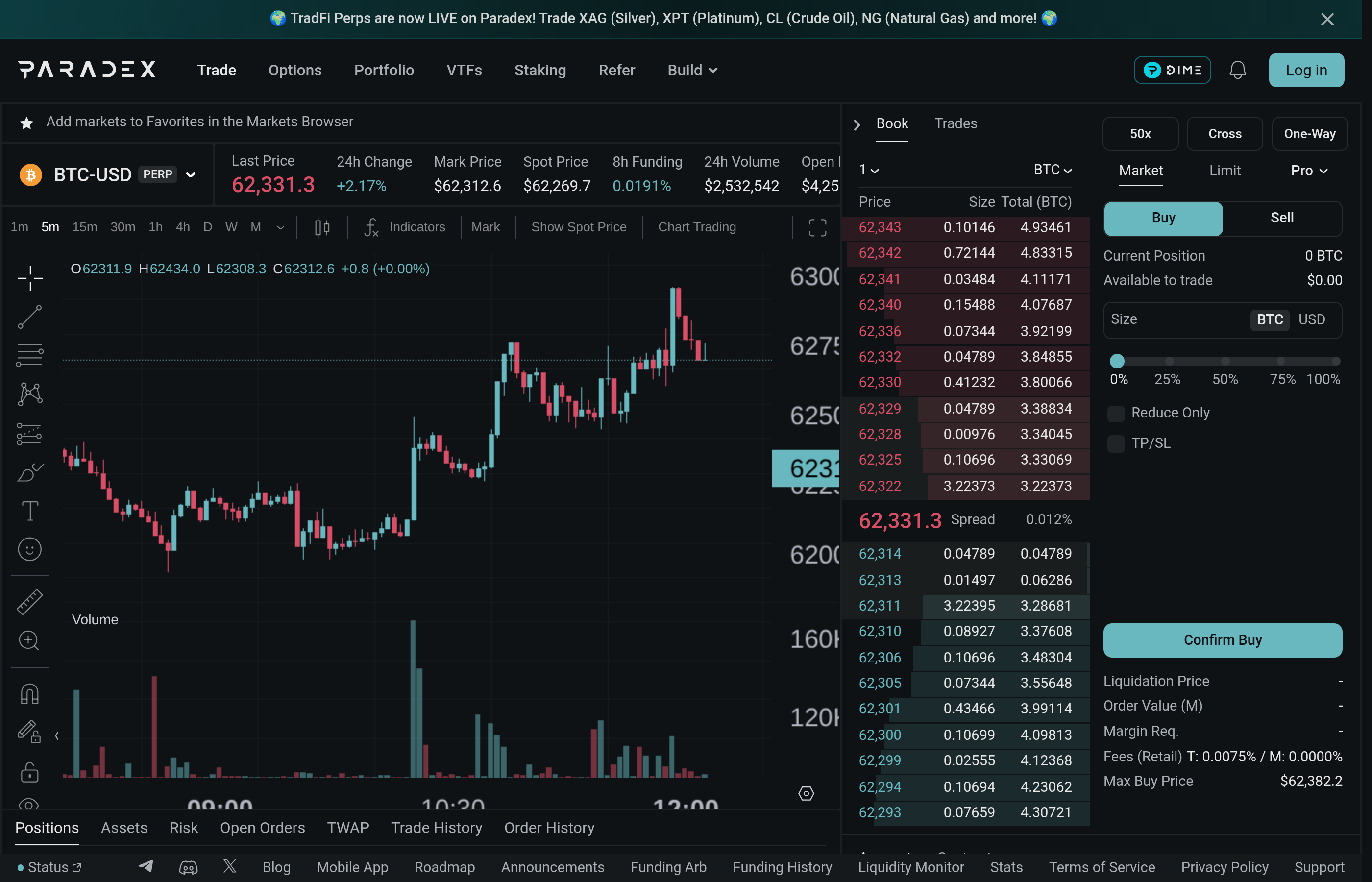
Two costs the order book is quietly charging you — the part beginners miss. (1) The bid/ask Spread shown in the book (about 0.012% on Paradex above) is what a market order pays to cross instantly; on a thin book this can be bigger than the funding you earn. (2) The Fees (Retail) line (Paradex 0.0075% taker) is charged on entry AND exit, on both venues. So your real break-even is roughly spread + taker, per leg, twice. On majors like BTC the book is deep and these are tiny; on thin alts use limit orders instead of market so you do not pay the spread.
- On Hyperliquid: choose Market (or Limit on thin books), Buy / Long, set Size to your token amount (e.g. 0.08 BTC), place the order.
- On Paradex: choose Market / Limit, Sell / Short, set the identical Size (0.08 BTC), confirm.
- Check both positions now show the same size with opposite signs. That is your delta-neutral pair, live and earning funding every settlement window.
Step 4 — Set a stop-loss and take-profit on EACH leg (the safety bracket)
This is the part that separates people who keep their capital from people who get a nasty surprise. A delta-neutral pair looks safe, but the two exchanges are separate venues — in a sharp dump or a violent impulse their prices can briefly diverge, and one leg can run toward liquidation faster than the other reacts. If that leg liquidates, you are suddenly naked and directional on the other one. The fix is a paired bracket on both legs, designed so the take-profit always fires first.
In plain terms: take-profit = "get me out safely, first"; stop = "if everything else failed, do not let this leg liquidate." You are not using the stop to chase profit (you are market-neutral, there is no directional target) — you are using the bracket purely as a circuit breaker so a cross-exchange price gap can never leave you with one liquidated leg and one open one. Set both orders the moment both legs are open, before you walk away.
Step 5 — Keep price in the middle of the channel (rebalance the legs)
Think of the stop and the take-profit as the two walls of a channel. Your job is to keep the price sitting roughly in the MIDDLE of that channel, equally far from the stop on one side and the take on the other — on both legs. The bracket is a safety net you never actually want to touch: if a sharp move pushes price to one wall, an order fires and your neutral position is broken. Staying centered is what keeps the net from ever catching you.
In practice the two exchanges drift apart over time — one leg gains margin, the other bleeds it, and price creeps toward the stop or take on one side. When you see one leg approaching its stop or take, rebalance: move collateral from the comfortable leg to the stretched one (top up margin on the leg that is drifting toward its wall). That recenters both legs so the price sits the same distance from its stop and its take again. A two-minute top-up every so often is the entire maintenance job — and it is what separates a position that quietly farms funding for weeks from one that gets stopped out on the first volatile candle.
A real money example: $5,000 at 5× leverage
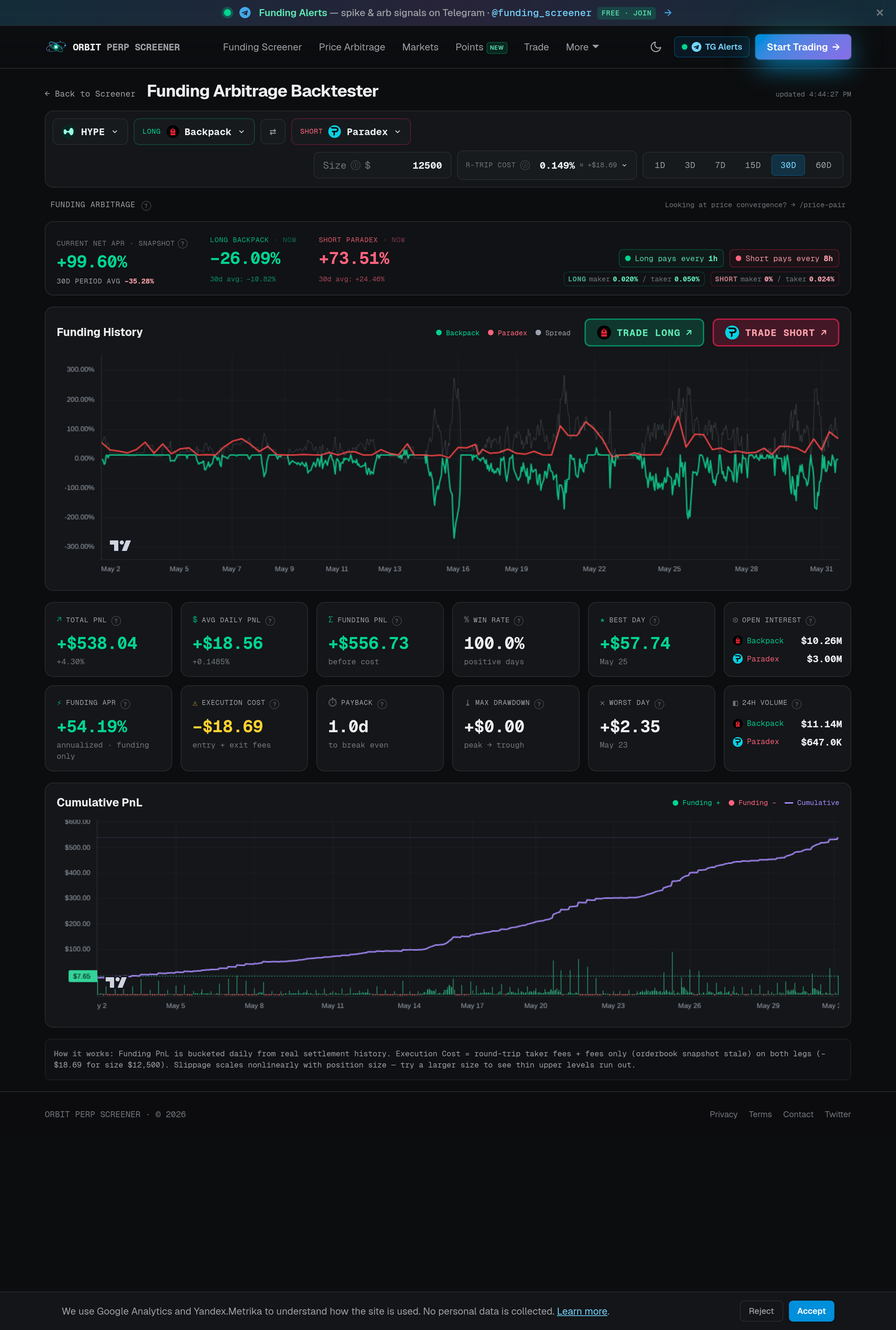
Here is the part everyone asks about. Say you have $5,000. At 5× leverage you control $25,000 of notional — split delta-neutral, that is a $12,500 long and a $12,500 short. That $12,500-per-leg size is exactly what the screenshots use, so these dollar figures are real, not scaled guesses.
- Over the last 7 days, the HYPE Backpack/Paradex pair returned +$197.24 net on $12,500 per leg. On your $5,000 of actual collateral, that is +3.9% in a week.
- Over the last 30 days, the same pair returned +$538.04 net — that is +10.8% on your $5,000 in a month, with 100% green days.
- Notice the APR cooled from ~79% (7-day) to 54% (30-day). High spreads compress as others pile in. The backtester shows you the realized number, not the fantasy.
Want more yield and can stomach thinner books? At capture time, KAITO on Paradex/Extended was printing well over 100% annualized. Those numbers are real but fragile — thin order books, faster decay. Treat a 120% APR as something that will revert, not a salary.
Step 6 — Prefer venues with an active points program
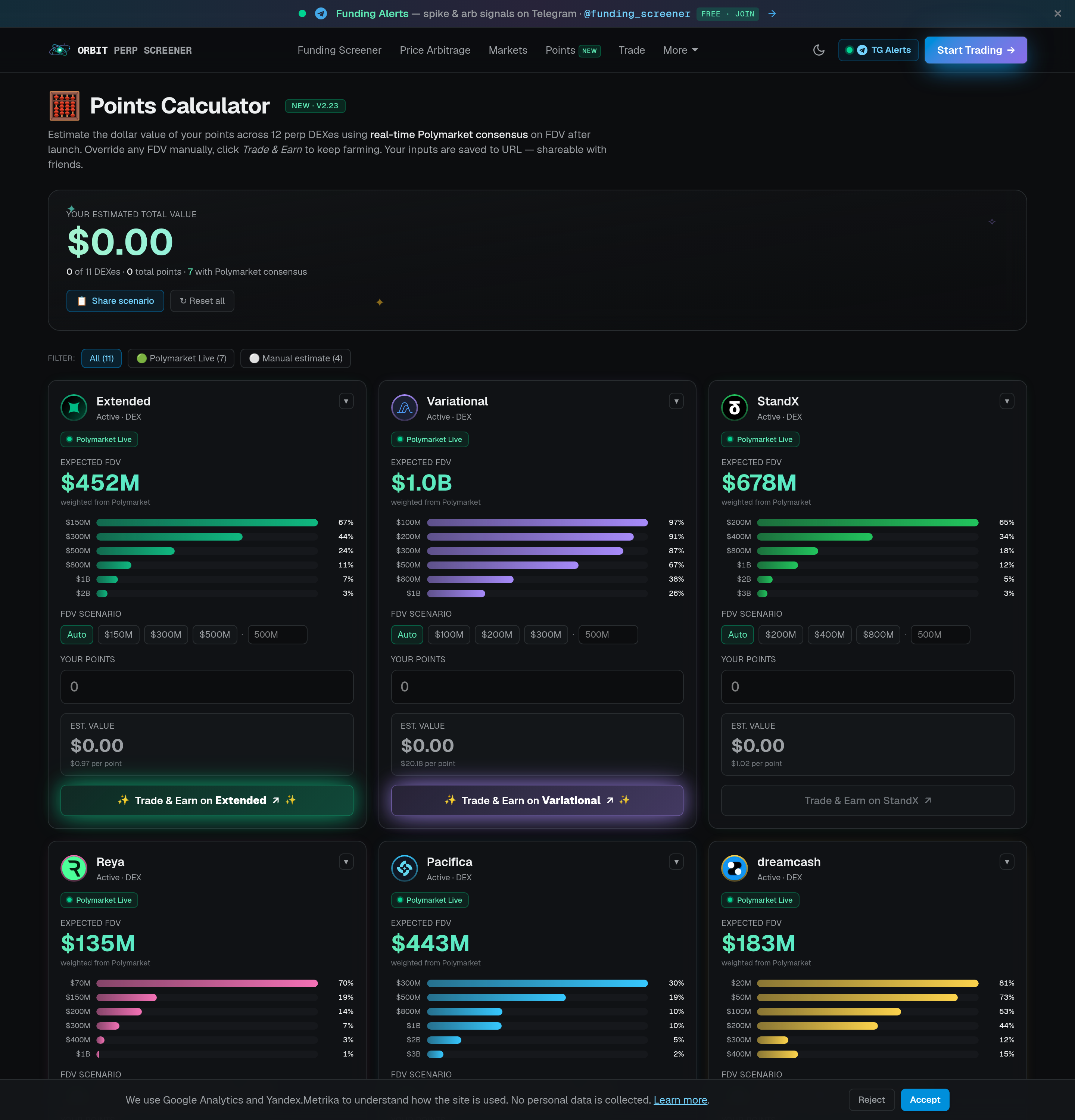
When two venues offer a similar funding spread, pick the one running an active points program. Several perp DEXs are still pre-token and reward trading volume with points that convert to a future airdrop you can sell once the token lists. If one of your legs sits on such a venue, you are earning the funding spread AND farming points on the very same position — two income streams from one trade, at no extra effort. Over a few weeks the points side can quietly out-earn the funding side.
Two ORBIT tools make this concrete. The Trade page (the "Trade" button in the menu) lists every venue with an active points program, so you can see at a glance which perps are worth farming right now. The Points Calculator then estimates the dollar value you would walk away with after listing — it pulls live Polymarket consensus on each project's launch FDV, so instead of guessing you get a probability-weighted number. Check both before you choose your legs: same spread, but one venue hands you a free airdrop on top.
Sign up through ORBIT for referral perks
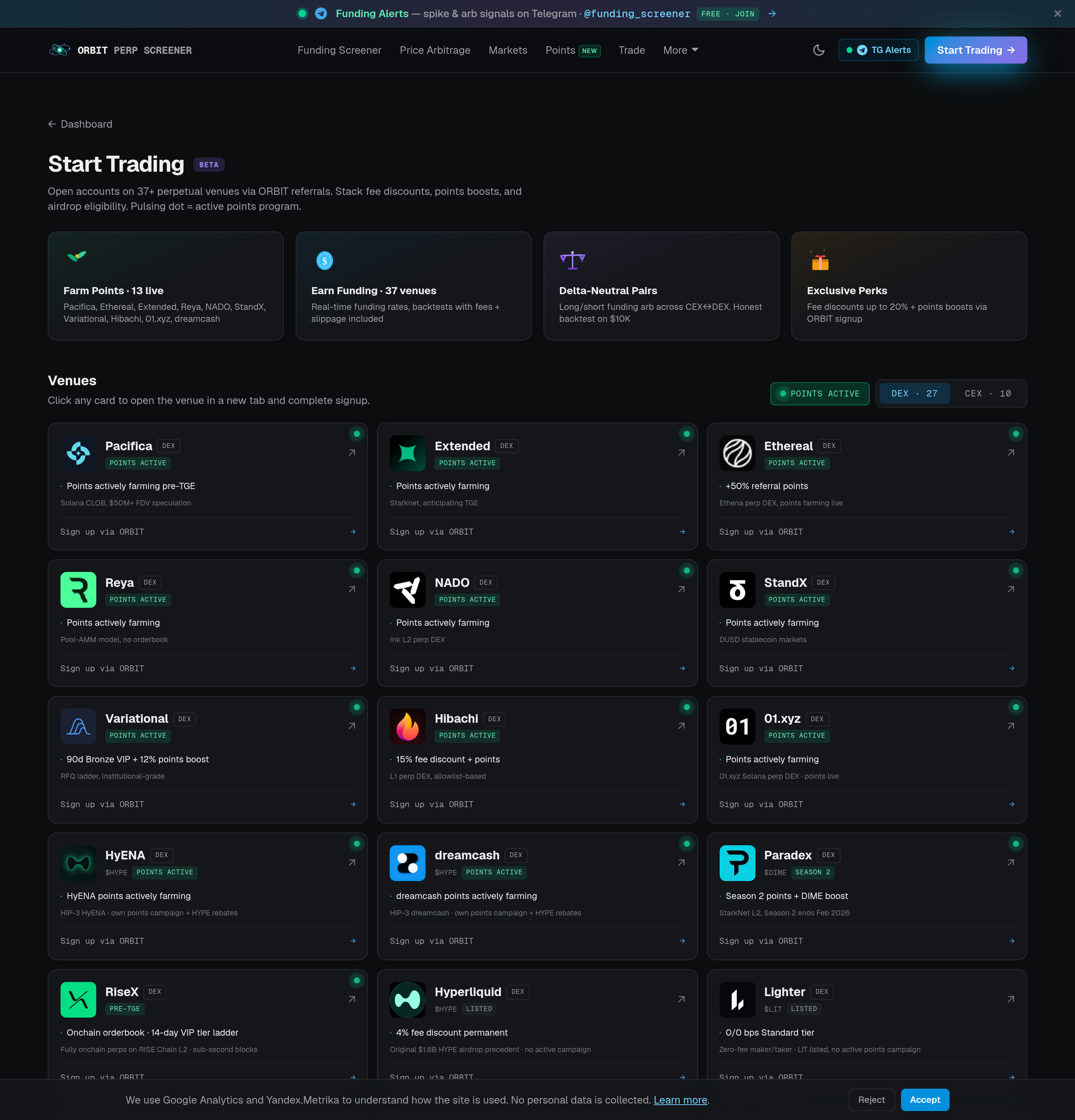
When you pick your venues, open them from the Trade page. Signing up through ORBIT's links applies each venue's referral perks automatically — and several are meaningful: Variational gives a 90-day Bronze VIP plus a 12% points boost, Hibachi a 15% fee discount, Ethereal +50% referral points, Hyperliquid a permanent 4% fee discount, Paradex a Season 2 DIME boost. Fee discounts go straight to your net PnL; points boosts compound the airdrop side.
What can go wrong (read before you size up)
Mitigations are boring and they work: size each pair small, keep a fat margin buffer, stick to legs with real depth (the Min OI filter exists for exactly this), and close a position the moment the spread drops below your break-even — ORBIT shows you that break-even on every pair page. The math edge is real; the discipline to keep it is the whole game.
Your first trade in 5 minutes
- Open the Funding Screener, sort by Spread, set Min OI to $1M.
- Click a green/red pair to open the backtester; confirm the 7- and 30-day net PnL are positive after cost.
- Check the Points Calculator — if your long leg is a points DEX, that is bonus yield.
- Open both venues from the Trade page to claim referral perks, then open equal long and short positions.
- Set a daily reminder to re-check the spread; close when it compresses below break-even.